Public Policy Initiatives
Economic Opportunities Analysis
The City of Portland is updating their economic opportunities analysis (EOA); a little-known state-wide planning requirement that identifies likely industrial and other economic development opportunities and corresponding employment land needs for the community. However, in this city, history has shown that this process typically results in further regulation on harbor businesses, impacting their growth. The City’s available industrial land supply is both constrained and diminishing. We are keeping close watch on the potential for additional regulation that can further restrict the harbor businesses’ operations, facility maintenance and development activities.
We are participating with other interested parties, in reviewing and commenting on the City of Portland EOA documents and will have a recommendation for our members to consider once the effort wraps up Summer of 2024.
Renewable Fuel Storage policy
- Renewable Fuels Standard – Technical Advisory Committee: WWC member companies have participants on this committee and other members have provided input to the committee.
- Fossil Fuel Terminal Ordinance: WWC has participated with other organizations in several challenges of this ordinance before the Oregon Land Use Board of Appeals.
Seismic Assessment and Preparedness:
WWC member companies are working to comply with the requirements of Senate Bill 1567 which gave Oregon DEQ the authority to develop a program to evaluate and prepare for a major seismic event.
MPAP was adopted by the City Council
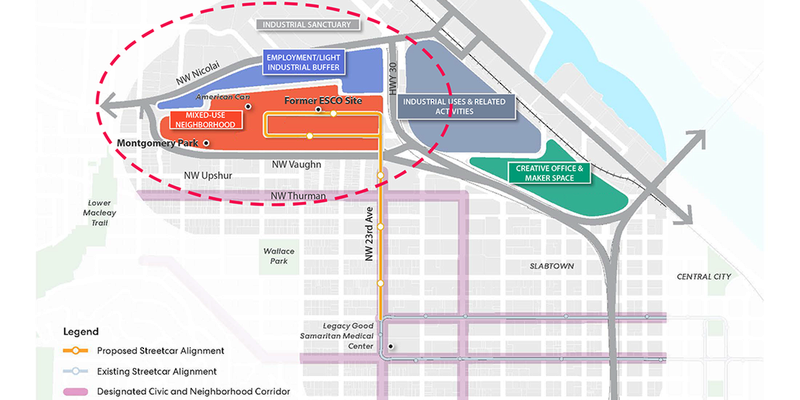
On Dec. 11, Portland City Council voted unanimously to adopt the Montgomery Park Area Plan (MPAP). This plan sets the stage for a new transit-oriented district in Northwest Portland west of Highway 30 between NW Vaughn Street and NW Nicolai Street. WWC worked with Columbia River Corridor Assoc.(CCA), NW Industrial Business Assoc (NIBA), and Northwest District Assoc. (NWDA) in testifying and advocating for the loss of Industrial Land and living wage jobs. We will continue to advocate for this in our work through the EOA.
- Montgomery Park Area Plan (MPAP) adopted. Click here for up-to-date information.
- Read the public testimony submitted by WWC in November and December 2024.
Stormwater Rate Changes
FEMA BiOp
We want to let you know about the work WWC put into the FEMA BiOp ordinance and the success had with the City Council from our advocacy – we met with ten of the twelve councilors and Council President Pirtle-Guiney took the lead on the amendments.
The FEMA BiOp is a temporary regulation that is required by the Federal government in order for Portlanders to receive Flood insurance. A letter was sent in July 2024 to the City – That letter stated local jurisdictions within the NFIP (National Flood Insurance Program) would be required to have in place “Pre-Implementation Compliance Measures (PICM)” no later than Dec. 1, 2024?. The purpose of these PICMs according to FEMA were to “ensure the continued existence of threatened or endangered species in compliance with the Endangered Species Act.” BPS reached out to WWC in the Fall to let us know about this letter and what the three options were that BPS had to choose from. We did not hear again from BPS until they testified at the City Council Committee meeting of the Climate, Resilience and Land Use Committee on ???. At this committee meeting, BPS stated that they let FEMA know they chose option one of the PICM which states “Adopt a model ordinance that considers impacts to species and their habitat and requires mitigation to a no net loss standard.”
BPS as well gave a 28 page amendment document to the current regulations and there were a group of Environmental activists that testified as well. The Council committee chose to delay the vote of the amendments to the next meeting. WWC was listening to this session but had no idea that BPS was going to present the amendments, several of which were very concerning to WWC. On June ?? the Committee voted 4-1 forwarding the amended ordinance to the full council for consideration. The full council meeting to consider the ordinance was scheduled for July 17 – a final vote on the ordinance was needed before July 31, 2025.
WWC jumped into action. We reached out to all of the City Councilors and BPS for meetings. We met with BPS for better understanding of the amendments and what they meant for our members. We were able to meet with all but two Councilors-meeting with some councilor’s multiple times. We worked closely with Council President Pirtle Guiney and her staff on adjusting the amendments to better favor the Industrial businesses. These amendments are below and quite a bit adjusted from what was originally requested from the Environmentalists and BPS.
Proposed Amendment Package 1 Council President Pirtle-Guiney
A) Ordinance: Section 1. The Council finds: … 27. The City acknowledges that the proposed PICM amendments represent temporary measures, and the Council anticipates adopting long-term compliance regulations as required to comply with federally mandated deadlines.
B) Exhibit A: 24.50.030 Flood Related Definitions. … AA. Functionally-dependent use means a use that cannot fulfill its intended purpose unless it is located or carried out in close proximity to water. For purposes of this Chapter, this definition applies only to structures and facilities such as bridge piers, docking facilities, port facilities that are necessary for the loading and unloading of cargo or passengers, and ship-building and ship-repair facilities, and similar uses. It does not include indirect uses such as and does not include long-term storage or related manufacturing facilities. BOLD RED – new definitions that are included red strikethrough – new definitions that are removed BOLD BLUE – original definition that are included blue strikethrough – original definition modified for wording
The above amendments were a huge win for WWC. We were able to change requirements, and votes at City Council, and were recognized for our meetings with the Councilors and our valuable input. Below please see our testimony, and Councilor Ryan and Councilor Kanal’s mention of the importance of WWC.
WWC Testimony 14:55 https://youtu.be/aI8VPn8ASDw?t=891
Councilor Ryan 44:06 https://youtu.be/aI8VPn8ASDw?t=2644
Councilor Kanal: 48:16 https://youtu.be/aI8VPn8ASDw?t=2895
Reports & Studies
Working Waterfront Coalition Overview
For a great overview of what the working waterfront harbor looks like and statistics to support the importance of working wage jobs, please see this excellent presentation by former Executive Director, Ellen Wax.
News & Events
For media inquiries or interviews, please contact Tanya Hartnett, Executive Director, at 503.220.2064 or Tanya.Hartnett@workingwaterfrontportland.org
Working Waterfront Coalition announces Scholarship Endowment with Portland Community College Foundation
WWC is proud to announce that it has set up an endowment with Portland Community College Foundation. Founded in 2005, WWC is committed to a long-term legacy as both a coalition and providing training for working wage Jobs.
The scholarship fund at the PCC Foundation spans more than a decade. WWC’s investment has had a profound impact on the lives of PCC students studying the trades. This investment in education fuels the local and regional economy as scholarship recipients go on to secure working wage jobs and make untold contributions to their communities. In creating the endowment, WWC is ensuring support for student scholarships which are not only available today, but that it grows and continues in perpetuity, providing a much-needed, trained workforce to the industrial sector.
Please support the training of much needed industrial employees by donating now.
Contact Tanya Hartnett (tanya.hartnett@workingwaterfrontportland.org) for more information on how to support the endowment or if you want your gift to be tax deductible.
Portland City Council Hearing | Montgomery Park Area Plan
This month, the newest recommended draft of the Montgomery Park Area Plan (MPAP) will be made public. housing and commercial land. The public hearing and testimony for this draft’s review is scheduled for Wednesday, November 13th at 2:00 p.m.
The MPAP site is land currently zoned for industrial use, and if this draft is passed, MPAP will be rezoned for mixed-use i.e. housing and commercial. This is a problem for two reasons:
1. Our industrial land provides more family-wage jobs for people of color and people without four-year degrees than any other sector. Additionally, our data indicates this holds true for LGBTQ+ communities as well.
2. Portland is essentially out of industrial land. If an industrial business has to move from the NW industrial zone, they will almost certainly have to move out of Portland, along with those family-wage jobs for our most vulnerable populations.
Although not in the Columbia Corridor or Swan Island, a shortage of industrial land supply is a common issue we face throughout Portland.
We encourage you to make a testimony on November 13th to share your thoughts on the draft plan.
Mayoral Forum
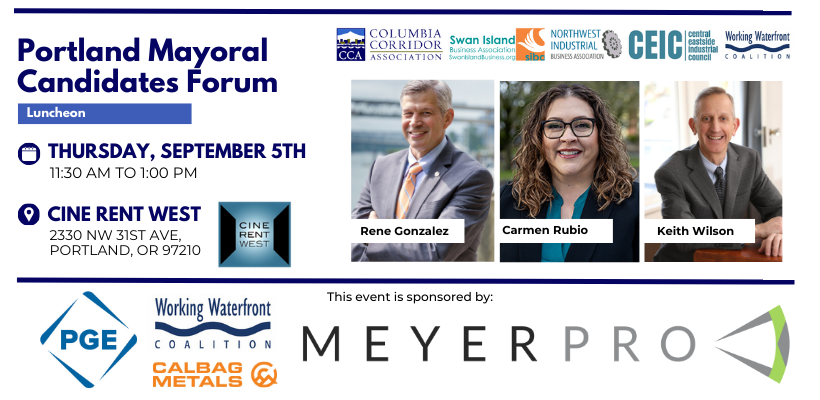
Portland’s Industrial Districts welcomed over 100 people on the morning of September 5th to hear the top three contenders for Portland’s next Mayor; Carmen Rubio, Rene Gonzalez, and Keith Wilson. Each candidate captivated the audience with inspiring perspectives and bold visions for the future, tackling some of the city’s most urgent issues.
Special thanks to our sponsors for making this event possible: MeyerPro, Columbia Corridor Association, Swan Island Industrial Business Association, Northwest Industrial Business Association, Central Eastside Industrial Council, Calbag Metals, Portland General Electric, and Cine Rent West!
Op-Ed by Executive Director Tanya Hartnett
The August 2024 issue of the North Peninsula Review will highlight the WWC as an organization. In addition, the op-ed clarifies the WWC’s role as an active participant in the City of Portland’s process for the update to the Economic Opportunities Analysis that is a critical component for the preservation of industrial land zoning policies.
North Peninsula Review, Op-Ed, July 2024 — Portland Harbor Industries; Empowering our Future
By Tanya Hartnett, Executive Director, Working Waterfront Coalition
Looking out at the Willamette River, you see large scale operations that are served by ship, rail and truck. What may look like a solitary enterprise, is actually part of an economic ecosystem of industries largely dependent upon the water for their operation but also upon one another for product, supplies or the next step in the supply chain.
These businesses were established in the Portland Harbor as early as the late 1800s . . . Read More
Industrial jobs and manufacturing offer a lifeline to Portland and the state – Will they take it?
The City of Portland is updating their economic opportunities analysis (EOA); a little-known state-wide planning requirement that identifies likely industrial and other economic development opportunities and corresponding employment land needs for the community. However, in this city, history has shown this process typically results in further regulation on harbor businesses, impacting their growth.
Now more than ever, Oregon needs a healthy private sector to provide jobs, preserve urban vitality, support rural productivity, while generating revenue for critical public services.
– Ellen Wax, Former Executive Director